
Fritz Hansen Leather Guide
Fritz Hansen offers a wide selection of leather types so you can find the option that best suits your space. Each leather has its own characteristics, and understanding these will help you choose the one that matches your needs and expectations.
When selecting leather, there are many aspects to consider:
Do you prefer the soft comfort of a more organic leather, the unique character of a hide with natural markings, or the uniform look of a more even surface? Is easy maintenance important, or do you value the way leather develops a patina over time?
This guide introduces the different leather types, their qualities, and their advantages, helping you make an informed choice. With the right knowledge, you can select the leather that not only fits your needs today but also continues to meet your expectations in the years to come.
Leather Types

Aniline
Aniline leather is renowned for its exclusivity and natural beauty, with only 5% of all raw hides meeting the standards required for this premium material. Its natural open surface not only enhances comfort and feel but also underscores the leather’s sophisticated character.
The absence of a surface coating reveals the leather’s inherent natural marks, such as scars and wrinkles, each adding to its unique story. This open-pore structure allows the leather to breathe and develop a distinctive patina over time, evolving with exposure to light, grease, and everyday use. While a dyed aniline leather can fade with prolonged sunlight, a natural aniline darkens and gains depth, further enriching its exclusive charm.

Semi-Aniline
Semi-aniline leather combines the natural beauty of its surface structure with added durability while retaining the hide’s natural marks. Only 10- 15% of raw hides meet the standards required for semi-aniline leather, ensuring that it offers both quality and a refined aesthetic.
Unlike aniline leather, which remains untreated, semi-aniline leather receives a light surface finish. This finish enhances the leather’s resistance to stains and simplifies maintenance, making it less susceptible to grease and light exposure while preserving its natural appearance.
Despite its light surface finish, semi-aniline leather retains the same excellent sitting comfort and rich texture.

Protected
Protected leather is pigmented and undergoes extensive surface treatment, often including sanding or embossing with an artificial grain. This process results in a uniform appearance with minimal natural marks visible on the surface.
While protected leather is valued for its robustness, durability, and ease of maintenance, its heavy surface treatment means it does not offer the same breathability and softness as aniline or semi-aniline leathers. However, it still provides a comfortable seating experience.
A Natural Material
Leather is prized for its natural beauty and durability. The surface of each hide bears witness to the active life of the animal. Insect bites, scars and wrinkles are all normal features of leather, adding to its unique and characterful expression.
Natural Marks
Typical characteristics of leather include:
• Insect bites
• Scars
• Wrinkles
• Freckle marks
• Pigmentation variations
• Grain variations
• Hair whorls
• Neck wrinkles
• Fat stripes
Natural Markings

Fat Stripes
The fat content in the hide affects dye absorption, creating natural irregularities in the leather.

Neck Wrinkles
Natural deep grooves found in leather, formed by the folds and movement of the animal’s neck.

Wrinkles
In highly pigmented leather, surface treatment can increase the visibility of wrinkles when it is upholstered.

Insect Bites
Slight markings and scars left behind by insect bites.

Freckle Marks
A natural pigmentation in the leather hide.

Scars & Scratches
Naturally healed markings from the animal’s life, such as fence scratches or insect bites.

Pigmentation Variations
Dye absorption varies across the hide due to natural differences in grain, density, and thickness.

Grain Variations
The leather’s surface structure varies based on the hide’s natural characteristics and the finishing process.

Hair Whorls
Natural markings formed by the cow’s fur growth patterns.
Examples are for illustrative purposes only; all hides are carefully selected to minimise natural imperfections.

Choosing A Leather Type
How To Choose The Leather That’s Right For You?
To make the right choice for you and your needs, it can help to answer the following questions:
• Do you prefer natural leather (untreated leather)?
• How practical must the leather be?
• How important is ease of maintenance?
• Are there children and/or pets in the household?
• Should the leather have a natural look or a clean, uniform look?
• How much sunlight will the product be exposed to?
Answering these questions can help guide you towards the leather that best suits your lifestyle, preferences and expectations for the material’s natural development over time.
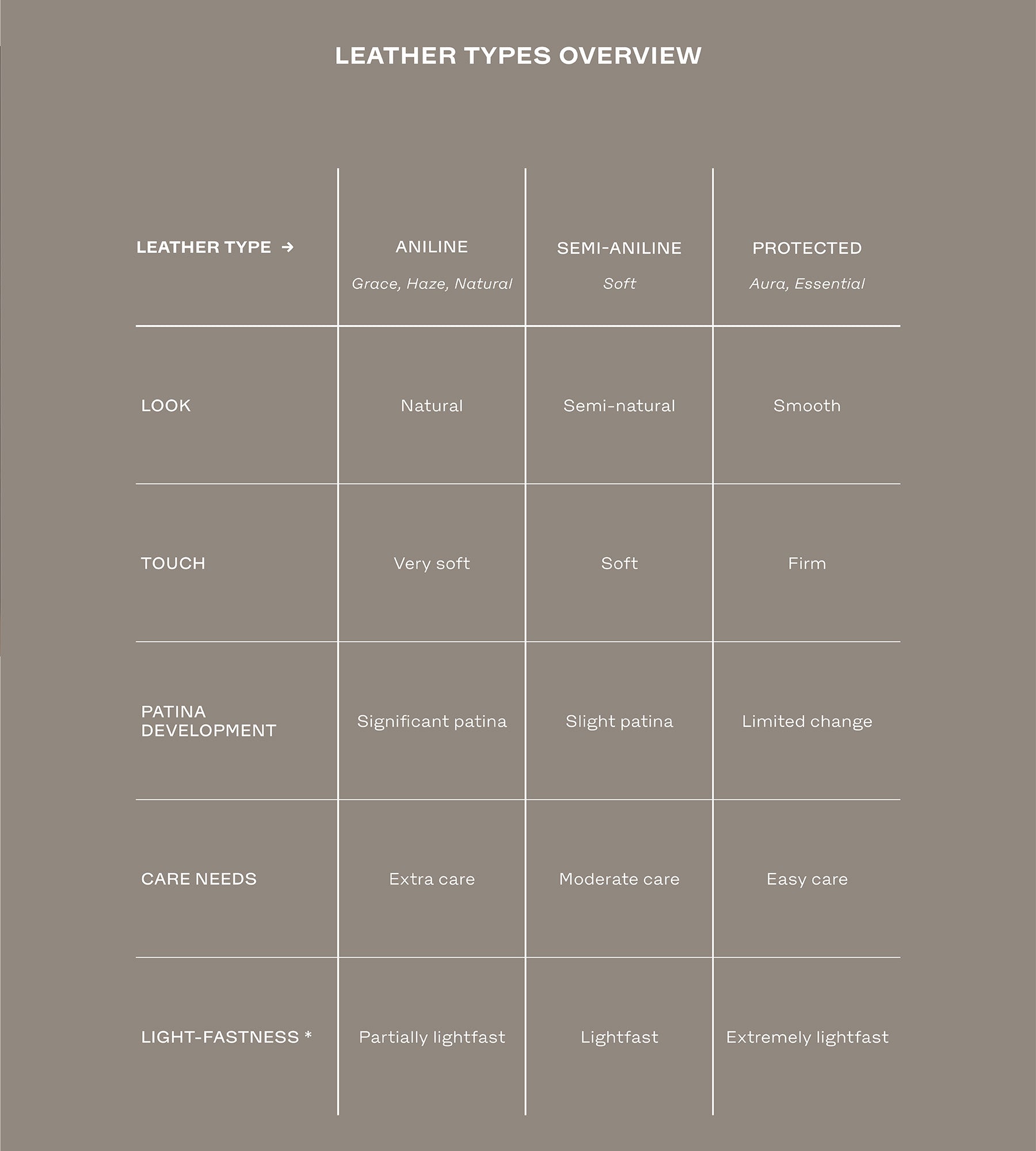
* Prolonged exposure to sunlight can cause certain leather types to fade and dry out over time. UV rays break down the natural oils in leather, leading to moisture loss, increased brittleness, and colour fading. If your leather piece will be exposed to significant direct sunlight, consider selecting a leather type with higher lightfastness to maintain its beauty and longevity.
A note about Patina ... Basic leathers are coated and so are easy to clean and maintain and keep looking perfect, they do however lack the unique properties of a natural leather. Natural leathers does not resist life, they records it and will evolve over the time that you own it to tell its own story alongside yours. Each mark is not a fault, but a marker in history.
Care & Maintenance
Leather, being a natural material, benefits from proper care to maintain its long-lasting appeal. The care and maintenance of leather will vary depending on its use, environment, and frequency of use. With a few simple steps, you can preserve the leather’s natural beauty, allowing it to become even more refined over time.
It is not necessary or recommended to protect your leather with any stain repellent upon the arrival of your new piece of furniture. However, we recommend vacuuming the leather furniture regularly with a soft brush nozzle. This applies to all leather from Fritz Hansen. Failing to do so will allow dust to fill up the pores of the leather, especially aniline and semi-aniline leather, which will compromise their comfort attributes and prevent natural breathing.
Cleaning
We recommend vacuuming your leather furniture once a week to maintain its condition. This is especially important for aniline and semi-aniline leathers, where the open pores can trap dirt. Always vacuum the entire surface before cleaning.
ANILINE LEATHER
The most important thing for aniline leather is to vacuum and keep the pores free from dust, as this will otherwise clog up the pores. If the need arises, give the leather some grease for further maintenance. We recommend washing the leather with a solution of soap flakes. Please only use soap flakes of a quality that contains 80% natural fat. See instructions. Aniline leather can absorb water differently and may appear with blotches during the process. Have faith in the process, and make sure to wash evenly so that all surfaces are treated.
SEMI-ANILINE LEATHER
Semi-aniline leather can also be wiped over with a well-wrung cloth on a regular basis. Avoid soaking the leather, and follow with a dry cloth. If necessary, apply some grease for further maintenance. We recommend washing the leather with a solution of soap flakes. Please only use soap flakes of a quality that contains 80% natural fat. See instructions. Remember to vacuum before washing with soap flakes.
PROTECTED LEATHER
If necessary, daily cleaning with a well-wrung cloth is possible. Use hot water, but cleaning agents are not needed. Follow the cleaning with a dry cloth.
Instructions
Clean only when necessary.
If cleaning is required, follow the directions below:

STEP 1
Vacuum clean the entire surface area to remove all traces of dust. Use a soft brush attachment.
STEP 2
Dissolve 2-3 tablespoons of soap flakes in a bucket with 1 litre/34 oz of hot water.

STEP 3
Whip the mixture to create a foam. Soap flakes must be fully dissolved before moving on to the next step.
STEP 4
When the mixture has cooled to a comfortable temperature, dip a soft cloth into the mixture and wring out any excess water.

STEP 5
Scoop the foam from the surface and gently apply it to the leather. Make sure that all leather surfaces are treated equally.
STEP 6
Allow the surface to dry before gently buffing it with a soft cotton cloth.

Stain Removal
Spot cleaning is not recommended for leather as it can cause discolouration. Instead, treat the entire surface area with soap flakes as recommended above.
Damage caused by stain removers is not covered by the Fritz Hansen warranty.
CAUTION!
Avoid using cleaning products and sharp objects on leather. Sharp objects can scratch and damage the leather.
• Textile dyes from non-colourfast clothing may cause permanent discolouration, especially on leather types with a natural surface finish (Grace, Natural, Haze).
• Avoid placing in direct sunlight for extended periods of time or close to heat sources.
FAQ
Leather
How is the leather sourced?
All Fritz Hansen leather is sourced responsibly from European cattle as by-products of the meat and dairy
industry, ensuring that no cattle are raised or slaughtered solely for their hides.
What are the different leather tanning methods?
Tanning is the process of transforming raw hides into durable leather, preventing decay while enhancing softness, moisture resistance, and longevity. Dating back to the 11th century, the term “tanning” comes from tannin, a natural acid found in trees and plants. Today, two of the most common tanning methods are chrome tanning and vegetable tanning, each offering distinct qualities suited to different applications.
• Vegetable tanning uses natural extracts from trees, bark, and fallen fruit - notably Mimosa, Quebracho, and Tara trees. Vegetable tanning is a traditional, time-intensive process requiring specialised craftsmanship. With only a few tanneries worldwide mastering this method, vegetable-tanned leather makes up just 10% of global leather production. It results in sturdy leather that develops a rich patina over time, making it ideal for high-end and artisanal products.
• Chrome tanning: chromium III is a naturally occurring element found in soil, plants, and food, and is widely used in modern leather production. Essential for human metabolism and meeting strict EU environmental standards, chromium III salts account for 85% of global leather tanning. This method is faster, more versatile, and produces soft, lightweight leather, making it the preferred choice for a wide range of applications.
Which tanning method is best?
Chrome tanning offers efficiency and flexibility, while vegetable tanning prioritises tradition, durability, and natural aging. The choice depends on leather properties, intended use, and sustainability considerations. Both methods contribute to the rich diversity of leather products available today, each catering to specific needs and preferences.
What’s the difference between aniline, semi-aniline, and protected leather?
• Aniline leather is the most natural, with no surface coating - soft, breathable, and rich in character.
• Semi-Aniline has a light protective layer for added durability while maintaining a natural look.
• Protected or pigmented leather has a surface finish that hides natural marks and makes it more resistant to stains and fading.
Does all leather develop a patina?
No. Only untreated or lightly treated leathers like aniline and vegetable-tanned types develop a patina. Protected and chrome tanned leathers retain their original look for longer.
Can I use stain protection or leather spray?
We do not recommend using stain repellents. Instead, regular vacuuming with a soft brush keeps leather clean and breathable.
Will sunlight damage leather?
Yes. Prolonged exposure to direct sunlight can fade or dry out leather. We recommend placing furniture away from heat sources and strong sunlight.
What’s the best leather for homes with children or pets?
Protected leathers like Aura or Essential are more durable and easier to maintain, making them ideal for high-traffic areas or family use. At the same time, many appreciate how unprotected leathers develop character more quickly, with patina and markings that reflect everyday life with children or pets. Natural leather does not resist life, it records it and it will evolve over the time that you own it to tell its own story alongside yours. Each mark is not a fault, but a marker in history.
Cleaning
How often should I clean my leather furniture?
Vacuum regularly with a soft brush to keep the pores free of dirt and dust particularly for aniline and semi-aniline leathers. For deeper cleaning, use a foam of natural soap flakes as needed - only when the leather shows signs of stains or dryness. See cleaning guide on page 9.
How often should I vacuum my furniture?
We recommend vacuuming your furniture once a week using a soft brush attachment.
Can I use any type of soap flakes to clean leather?
We recommend using soap flakes made from natural animal fat with a high fat content (around 80%).
Should I use warm or cold water when mixing soap flakes?
Always use warm water. Ideally, use boiled water that has cooled to a safe temperature—this reduces mineral content (like chalk) and helps the soap flakes dissolve fully.
How much water should I use to clean leather furniture?
A classic blend is 2–3 tablespoons of soap flakes to 1 litre of warm water. This is typically enough to clean even larger pieces of furniture.
How should I mix the soap flakes and water?
Whisk the solution by hand or use a hand mixer to create a rich foam. You should use the foam - rather than the water itself - for cleaning, as it is gentler and prevents over-saturation.
Can I remove a stain from leather using soap flakes?
When treating stains, it’s important to wash the entire surface - not just the stained area. Spot cleaning can result in uneven colour, soap residue, or a visible ring. Always clean the whole piece to ensure a consistent finish.